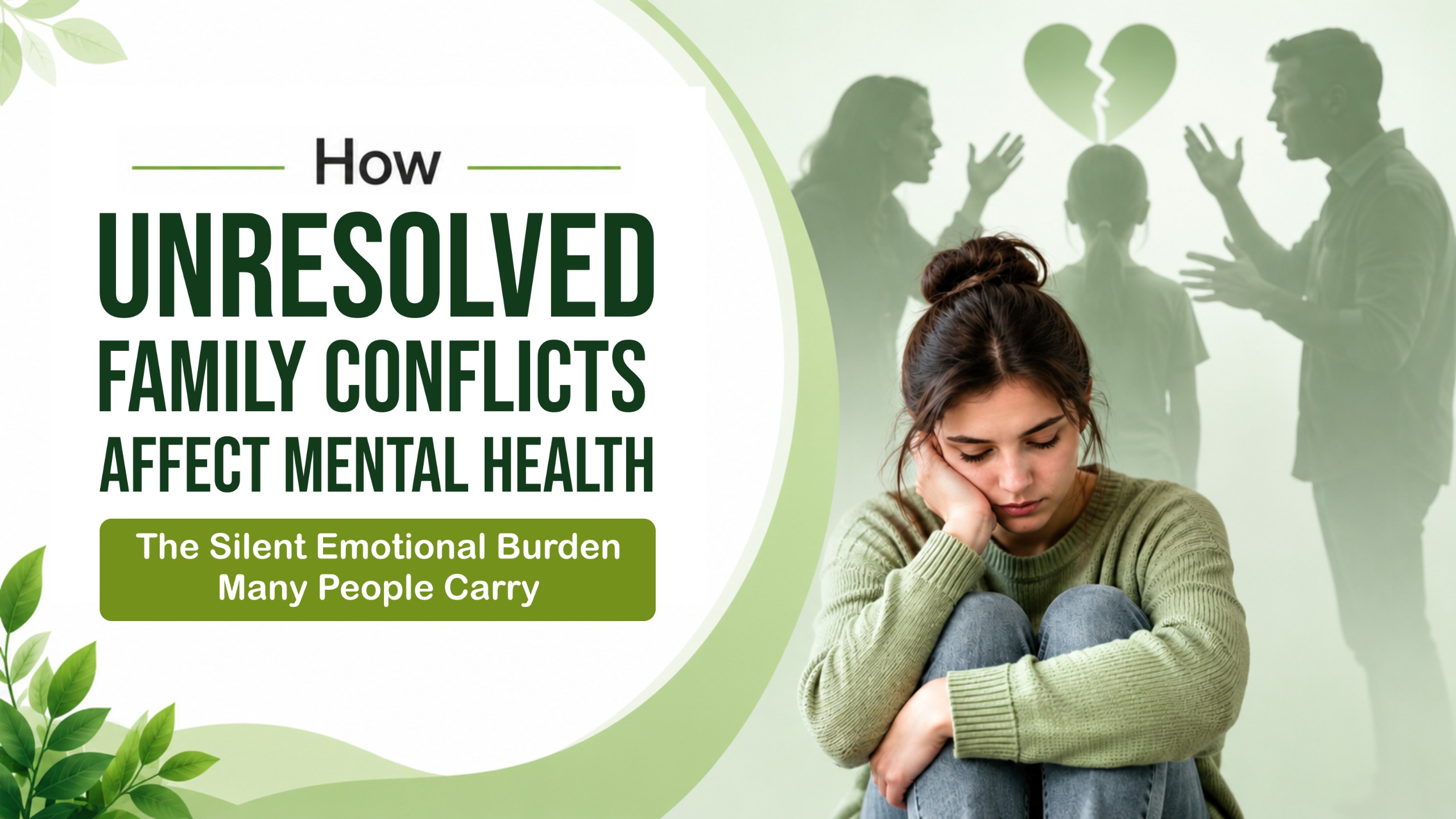
How Unresolved Family Conflicts Affect Mental Health
The Argument May End. But Does the Pain?
Think back to the last family disagreement you witnessed.
Maybe it was a heated argument between parents.
A misunderstanding between siblings.
A conflict over finances.
A disagreement about marriage, career choices, or responsibilities.
Now ask yourself:
Did the conflict truly end, or did everyone simply stop talking about it?
Many families learn how to avoid conflict.
Very few learn how to resolve it.
The result?
Invisible emotional wounds that quietly shape thoughts, emotions, relationships, and mental health for years.
The reality is that some of the deepest emotional struggles people face as adults do not begin at work, in college, or in relationships.
They often begin at home.
The Family: Our First Emotional Classroom
Before we learn mathematics, science, or language, we learn emotions.
At home, we learn:
Family is often the first place where we experience love, support, belonging, and security.
Unfortunately, it can also become the first place where we experience fear, criticism, emotional neglect, or unresolved conflict.
When conflicts remain unresolved for months or years, they can leave lasting psychological effects.
A Surprising Reality
Many people seek counselling for anxiety, depression, anger issues, low self esteem, or relationship problems.
As conversations deepen, a common pattern often emerges.
The root cause is not always the present situation.
It is often an unresolved emotional wound from the family environment.
What happened years ago may still be influencing today's emotions.
What Exactly Are Unresolved Family Conflicts?
Unresolved family conflicts are disagreements, tensions, emotional hurts, or relationship issues that remain unaddressed or inadequately resolved.
These may include:
The conflict itself is not always the problem.
The problem arises when emotions remain buried rather than healed.
The Hidden Mental Health Impact of Family Conflicts
Many people assume family issues stay within the family.
Unfortunately, emotional pain rarely remains confined.
It often follows us into adulthood, careers, friendships, and romantic relationships.
Let's explore how.
1. Chronic Family Conflict Can Increase Anxiety
Imagine living in an environment where tension feels constant.
You never know when the next argument will begin.
You constantly anticipate criticism, blame, or emotional confrontation.
Over time, your brain learns to stay on high alert.
This prolonged state of emotional vigilance can contribute to:
Many adults struggling with anxiety today developed hypervigilance during years of unresolved family tension.
2. Family Conflicts Can Lead to Depression
Humans are wired for connection.
When important family relationships become sources of pain rather than support, feelings of sadness and hopelessness may develop.
Common emotional experiences include:
Over time, these experiences can contribute to depression and emotional withdrawal.
The pain is often intensified because the hurt comes from the people whose support matters most.
3. Low Self Esteem Often Begins at Home
Consider these statements:
"You never do anything right."
"Why can't you be like your brother?"
"You will never succeed."
"Your opinions don't matter."
Repeated criticism can slowly become an internal voice.
Many adults with low self confidence are not struggling because they lack ability.
They are struggling because years of criticism shaped how they view themselves.
Family conflicts often influence:
Long after the words are spoken, their impact may remain.
4. Emotional Neglect Can Be as Harmful as Open Conflict
Not all family conflicts involve shouting.
Sometimes the greatest damage comes from silence.
A child may have food, clothing, education, and shelter.
Yet still feel emotionally unseen.
Emotional neglect occurs when emotional needs are consistently ignored.
Signs may include:
Many people carry these emotional wounds into adulthood without recognising their source.
5. Family Conflicts Can Affect Physical Health
Mental health and physical health are deeply connected.
Ongoing emotional stress can affect:
Research consistently shows that chronic psychological stress contributes to various physical health concerns.
The body often carries emotional burdens the mind struggles to process.
6. Relationship Problems Often Reflect Family Patterns
Have you ever noticed yourself reacting in relationships exactly the way a parent reacted?
Many people unknowingly repeat patterns learned during childhood.
Unresolved family conflicts may contribute to:
Without awareness and healing, family patterns often continue across generations.
7. Children Are More Affected Than Adults Realise
Children may not fully understand conflict.
But they always feel its emotional impact.
Many parents believe:
"We never argue in front of the children."
Yet children often sense tension through:
Research shows that prolonged exposure to family conflict can affect emotional development, academic performance, and long term mental health.
The emotional environment at home matters as much as the physical environment.
The Questions Many People Avoid
As you read this article, consider these questions:
If these questions feel uncomfortable, you are not alone.
Often, awareness is the first step toward healing.
Why Families Avoid Resolving Conflict
Interestingly, many families avoid conflict resolution not because they do not care.
They avoid it because they fear:
Ironically, avoiding difficult conversations often causes greater damage over time.
Silence rarely heals emotional wounds.
Healthy communication does.
Can Family Relationships Heal?
Yes.
Not every family conflict can be completely erased.
Not every relationship can be restored exactly as it was.
But healing is possible.
Recovery often begins with:
Most importantly, healing begins when people acknowledge that emotional pain deserves attention.
When Should You Seek Professional Help?
Consider seeking professional counselling if:
Family counselling and individual counselling can help uncover patterns, improve communication, and support emotional healing.
A Final Thought
Family conflicts are a part of life.
Unresolved family conflicts do not have to be.
The arguments we ignore.
The emotions we suppress.
The conversations we postpone.
Often remain with us far longer than we realise.
Healing does not mean pretending nothing happened.
Healing means understanding what happened, processing the emotions, and choosing a healthier path forward.
Because mental health is not shaped only by what happens inside our minds.
It is also shaped by the relationships that surround us
How Manam Foundation Can Help
At Manam Foundation, we understand that family relationships can be both a source of strength and a source of emotional pain.
Our experienced mental health professionals provide compassionate support for individuals and families dealing with:
Through counselling, guidance, and recovery focused care, we help individuals build healthier relationships and stronger emotional resilience.
You do not have to carry emotional burdens alone.
Healing begins with understanding.
And every family deserves the opportunity to heal.
Manam Foundation ,Lewis Road Bhubaneswar,751002